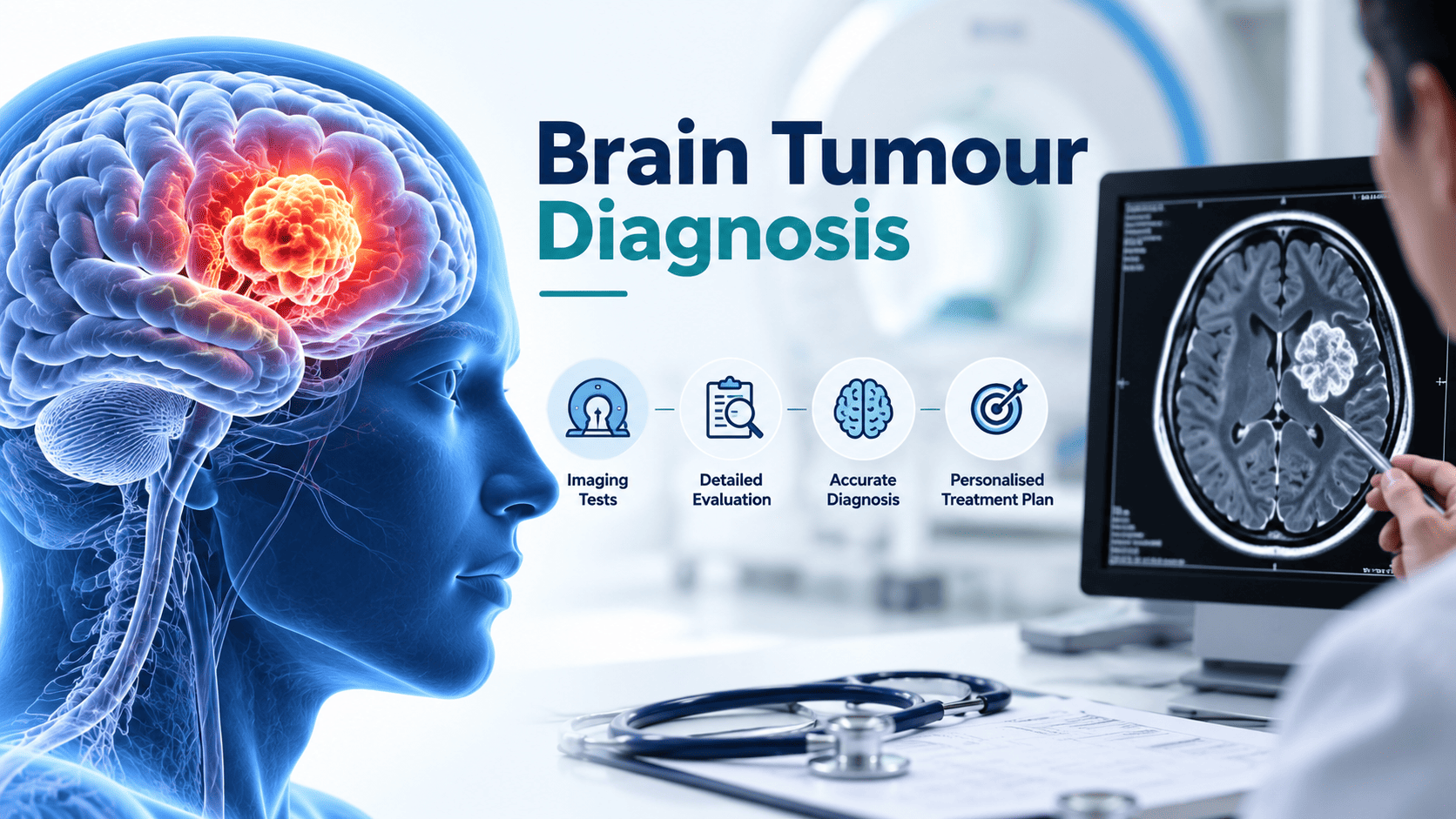
Getting a brain tumour diagnosis confirmed is one of the most overwhelming experiences a patient or family can go through. But here is something worth holding on to: most people who ultimately receive this diagnosis reach it through a clear, step-by-step medical process that begins with a conversation with their doctor. The path from symptoms to confirmed findings is not as uncertain as it may feel in the beginning.
Understanding how brain tumour diagnosis works in India helps patients and families stay grounded, ask the right questions and make informed decisions without panic. This blog walks you through exactly that.
Why Diagnosis Matters Before Treatment
Before any treatment decision is made, doctors need to know precisely what they are dealing with. A brain tumour is not a single condition. There are over 120 different types, each with its own behaviour, growth rate, and response to treatment. Without an accurate diagnosis, even the most skilled oncologist cannot build an effective plan.
This is why the diagnostic process in India, particularly at established oncology hospitals, is thorough and methodical. Rushing through it would not help you. Taking it one step at a time actually does.
Common Symptoms That Lead to Investigation
Most patients come to a doctor not knowing they may have a brain tumour. They arrive with symptoms that seem unrelated at first.
Common signs that prompt further evaluation include:
- Persistent headaches, especially those that worsen in the morning
- A new seizure with no prior history of epilepsy
- Gradual weakness or numbness on one side of the body
- Vision or speech changes that do not resolve on their own
- Memory lapses or personality shifts noticed by family members
- Unexplained nausea accompanied by headaches
If you or someone close to you is experiencing a combination of these symptoms, the right step is to see a neurologist or oncologist promptly, not to wait and watch.
Brain Tumour Tests Your Doctor May Recommend
Once a doctor suspects a neurological issue, they begin with a clinical neurological examination, checking coordination, reflexes, vision and memory. This helps identify which part of the brain may be involved before any scan is ordered.
From there, one or more of the following brain tumour tests are recommended:
MRI Scan
A brain MRI for tumour diagnosis remains single most detailed and ideal imaging tool available. It relies on magnetic fields and radio waves to produce HD images of brain tissue. In combination with contrast dye, it uncovers the tumor's size, location and how it relates to the structures around it with excellent clarity. In India, oncology hospitals that treat brain tumour patients use high-field MRI machines for this purpose.
CT Scan
A CT scan is faster than an MRI and is often the first imaging test done when a patient arrives in an emergency. It is effective for detecting bleeding, swelling or obvious masses and helps the team decide the urgency of the situation.
Biopsy
Imaging alone cannot confirm whether a tumour is benign or malignant or what type it is. A biopsy provides this confirmation, given a small sample of tumour tissue is removed and examined under a microscope. Many neurosurgeons in India perform stereotactic biopsies. It is a minimally invasive technique guided by imaging that lowers risk significantly.
PET Scan and Functional MRI
These advanced brain tumour tests help map the tumour's metabolic activity as well as its proximity to critical brain regions such as the speech or motor centres. They are particularly useful in surgical planning and in distinguishing a recurrent tumour from post-treatment changes.
Molecular and Genetic Testing
In India's leading oncology hospitals, brain tumour diagnosis now includes molecular profiling of the tumour tissue. Tests such as IDH mutation status, MGMT promoter methylation and 1p/19q co-deletion analysis provide information that directly influences which treatment will work best. An oncologist uses these findings to determine eligibility for targeted therapy or specific chemotherapy regimens.
What You Should Do After Diagnosis
Receiving a confirmed diagnosis is the beginning of a treatment journey, not the end of hope. Here is what the next steps look like in practical terms:
Seek a multidisciplinary opinion
A good oncology hospital will not leave your care to a single doctor. Neurosurgeons, radiation oncologists and medical oncologists review your case together through a tumour board before any treatment begins.
Ask about your tumour grade and type
This determines how aggressive treatment needs to be and what your long-term management will look like.
Do not delay a second opinion if you need one
India has several centres of excellence in neuro-oncology, and an experienced oncologist will welcome the process of ensuring you are comfortable with your care plan before proceeding.
Conclusion
A brain MRI for tumour diagnosis, followed by a biopsy and molecular testing, gives your medical team everything they need to design a treatment plan that is specific to your tumour rather than generalised. The diagnostic process in India has advanced significantly, and the support available at experienced oncology hospitals means you do not have to navigate it alone.
FAQs
Is a brain MRI for tumour diagnosis painful or risky?
MRI is a non-invasive test that uses no radiation and is pain-free. You will just need to lie below a scanner for about 30 to 45 minutes. If contrast dye is used, a small injection is given through a vein, which again is well tolerated.
Can brain tumour diagnosis be confirmed without a biopsy?
Imaging provides strong evidence. However, a biopsy remains the definitive way to confirm the tumour type and grade. In some cases, particularly with certain pituitary or acoustic tumours, clinical and imaging findings together are sufficient for a treatment decision without biopsy.
How long does the complete diagnostic process take in India?
At most oncology hospitals, the core diagnostic workup, including MRI, CT and initial blood tests, is completed within a few days. Results of the biopsy and molecular testing can take an additional one to two weeks. Following this, your oncologist will schedule a detailed consultation to discuss the findings.