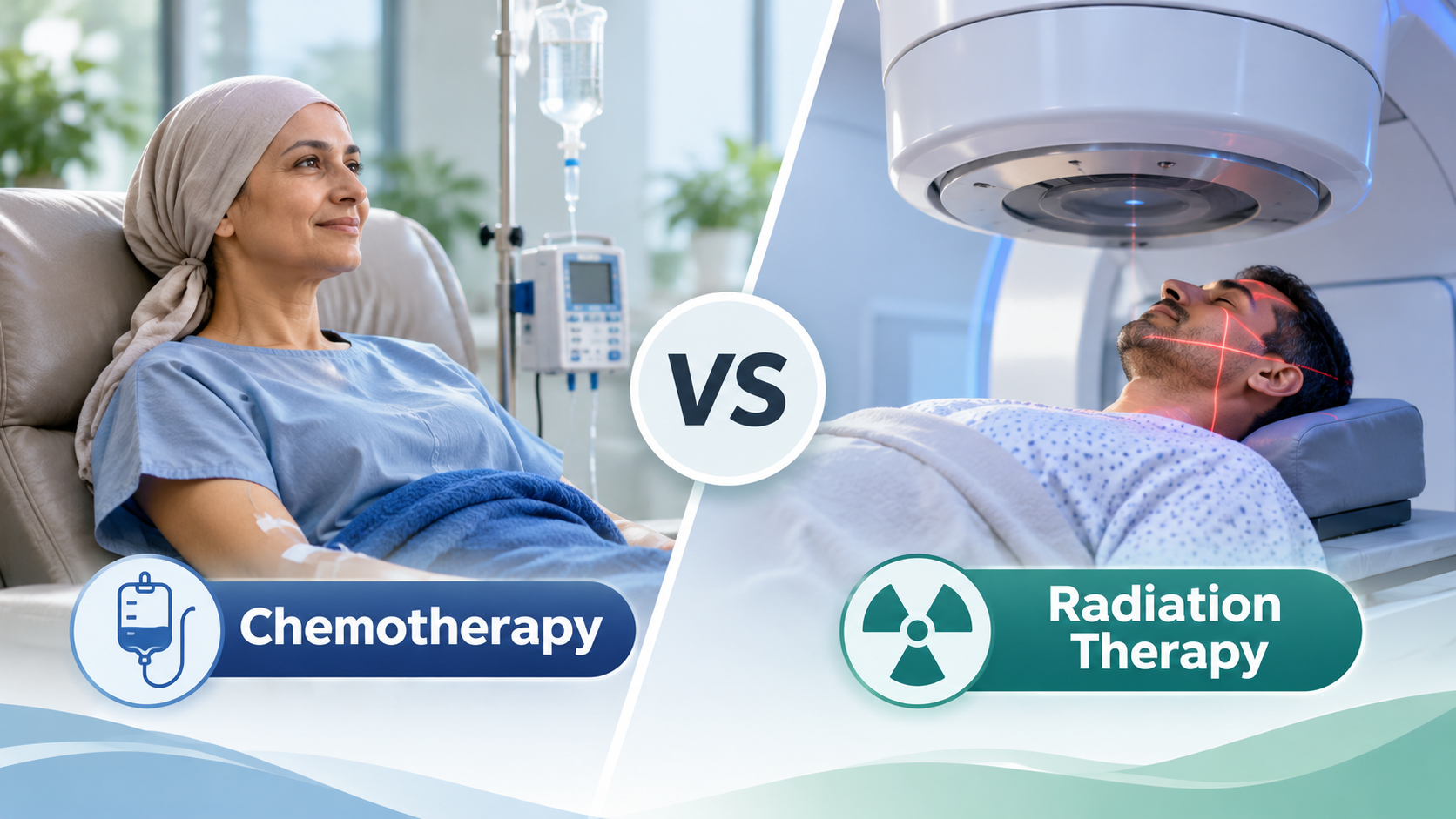

Getting a cancer diagnosis is hard enough. Then come the treatment conversations, and suddenly you are hearing words like chemotherapy and radiation in the same breath, often without anyone pausing to explain what either one actually means for your body, your daily life or your recovery. Most patients and families leave those early consultations with more questions than answers, and that is not their fault.
This blog exists to change that. Understanding the chemotherapy and radiation difference clearly, before treatment begins, helps you ask better questions, feel less overwhelmed and trust the process fully.
How Chemotherapy Works
Chemotherapy is drug-based cancer treatment. The drugs, delivered either through an intravenous drip or in tablet form, enter your bloodstream and travel through your entire body targeting cells that divide rapidly, which is exactly what cancer cells do.
This systemic reach is chemotherapy's biggest strength. When cancer has spread beyond one site, or when doctors suspect it may have without it being visible on scans yet, chemotherapy can follow it in a way that a localised treatment simply cannot.
In most oncology hospitals across India, chemotherapy is given in cycles, with rest periods in between to allow the body to recover. Many patients receive it in a day-care setting, arriving in the morning and heading home the same evening. Some regimens use oral drugs taken at home, depending on the cancer type and stage.
Cancers Commonly Treated with Chemotherapy
Chemotherapy is used across a wide range of diagnoses, including breast cancer, blood cancers such as leukaemia and lymphoma, lung cancer, ovarian cancer and cancers of the colon and rectum. It is sometimes given before surgery to shrink a tumor, and sometimes after surgery to reduce the chances of the cancer returning.
Side Effects Worth Knowing About
Because chemotherapy moves through the entire bloodstream, it affects healthy fast-dividing cells alongside cancerous ones. The side effects depend upon the drug chosen, not all chemotherapy drugs cause hairfall or nausea.This is why patients often experience hair loss, nausea, fatigue, mouth sores and a temporary dip in immunity.
These effects differ significantly from person to person. Many patients manage them well with supportive medication and close monitoring from their oncologist and care team. Most side effects ease once treatment ends.
How Radiation Therapy is Done
Radiation therapy uses high-energy beams, - gamma rays or x-rays, usually x-rays, focused precisely on a part of the body to damage cancer cells and stop them from growing. Chemotherapy is systemic, while radiation is localized. It stays focused on a defined treatment area. And this makes it particularly effective when a tumor is contained to one location.
Radiation technology has advanced significantly. Oncology hospitals in India now offer techniques such as Intensity-Modulated Radiation Therapy, Image-Guided Radiation Therapy, Arc therapy and most sophisticated stereotactic body radiotherapy (SBRT) & stereotactic radiosurgery (SRS) for brain tumors. These approaches allow the radiation beam to be shaped and adjusted with a level of precision that protects surrounding healthy tissue far better than older methods.
Cancers Commonly Treated with Radiation Therapy
Radiation therapy is widely used for cancers treatment, almost 70% of patients require radiation during their course of treatment.of the head and neck, brain, breast, cervix and prostate. It serves as the main treatment in some cases, like ca larynx & cervix and in others it is used after surgery to clear any cancer cells that may remain in the treated area eg-ca breast & oral cavity.
Side Effects Worth Knowing About
Since radiation is directed at a specific region, its side effects tend to be localised to that area. A patient receiving radiation near the throat may experience temporary difficulty swallowing. Someone receiving it to the chest may notice skin reaction. sensitivity or mild fatigue. Most of these effects settle after the treatment course ends, and your care team will manage them throughout.
When Both Are Used Together
The chemotherapy vs radiation conversation is not always a straight choice between one and the other. In many cancer types, oncologists use both simultaneously, a protocol called chemoradiation. Here, chemotherapy drugs sensitise cancer cells to the effects of radiation, helping it work more powerfully than it would alone.
This combination approach is widely used in India for cervical cancer, rectal cancer and cancers of the head and neck. The decision to combine treatments is never arbitrary. It comes from tumor board discussions where surgeons, medical oncologists and radiation oncologists review the case together before recommending a plan.
Ending Note
The question of chemotherapy or radiation therapy rarely has one universal answer, and it should not. Cancer treatment is not a formula. It is a plan built around you, your diagnosis, your overall health and what your body needs at this specific point in time.
Whether your treatment involves one, the other, or both together, every decision your oncologist makes is aimed at giving you the best possible outcome with the least possible disruption to your life.
FAQs
Is the main chemotherapy and radiation difference really just about where they work?
Yes, it is the clearest way to understand it. Chemotherapy circulates through the whole body, hence it’s a systemic therapy. and is suited to cancers that have spread or might have spread. Radiation is a local treatment stays targeted to one particular area. Your oncologist chooses based on where the cancer is, how it is behaving and what the scans show.
Will chemotherapy vs radiation cause permanent damage to the body?
Most side effects from both treatments are temporary and improve once the treatment course ends. Some patients experience longer-term effects depending on the treatment area, drug type and dosage involved. Your oncologist will go through the specific risks for your case before anything treatment begins, so there are no surprises.
How does my oncologist decide between chemotherapy or radiation therapy for my case?
The decision comes after a full review of your biopsy, imaging, cancer stage and general health. At a good oncology hospital, this is not a single doctor's call. A multidisciplinary tumor board reviews the case and arrives at a recommendation together, which is then explained to you clearly before treatment starts.