When a doctor mentions the word "lymphoma," most people hear one thing: cancer. What follows is usually a wave of questions, and one of the most common ones is this: “Is it Hodgkin's or Non-Hodgkin's?”
This distinction matters far more than it might seem at first. The type of lymphoma you have shapes everything that comes after: how it is staged, how it behaves and how it is treated. Understanding the difference is not just medical knowledge. For you or someone you love facing this diagnosis, it is the foundation for making informed decisions.
What Is Lymphoma, and Why Does the Type Matter?
Lymphoma is a cancer of the lymphatic system, which is part of the body's immune defence network. It starts in lymphocytes, a type of white blood cell. Swollen lymph nodes in the neck, armpit or groin are often the first visible sign, though lymphoma can also affect the spleen, bone marrow and other organs.
The two types are not simply mild and severe versions of the same illness. They arise from different cells, follow different patterns of spread, respond to different treatments and carry different outlooks. Knowing which one you are dealing with changes the entire clinical conversation.
Hodgkin's Lymphoma vs Non-Hodgkin's Lymphoma: The Core Difference
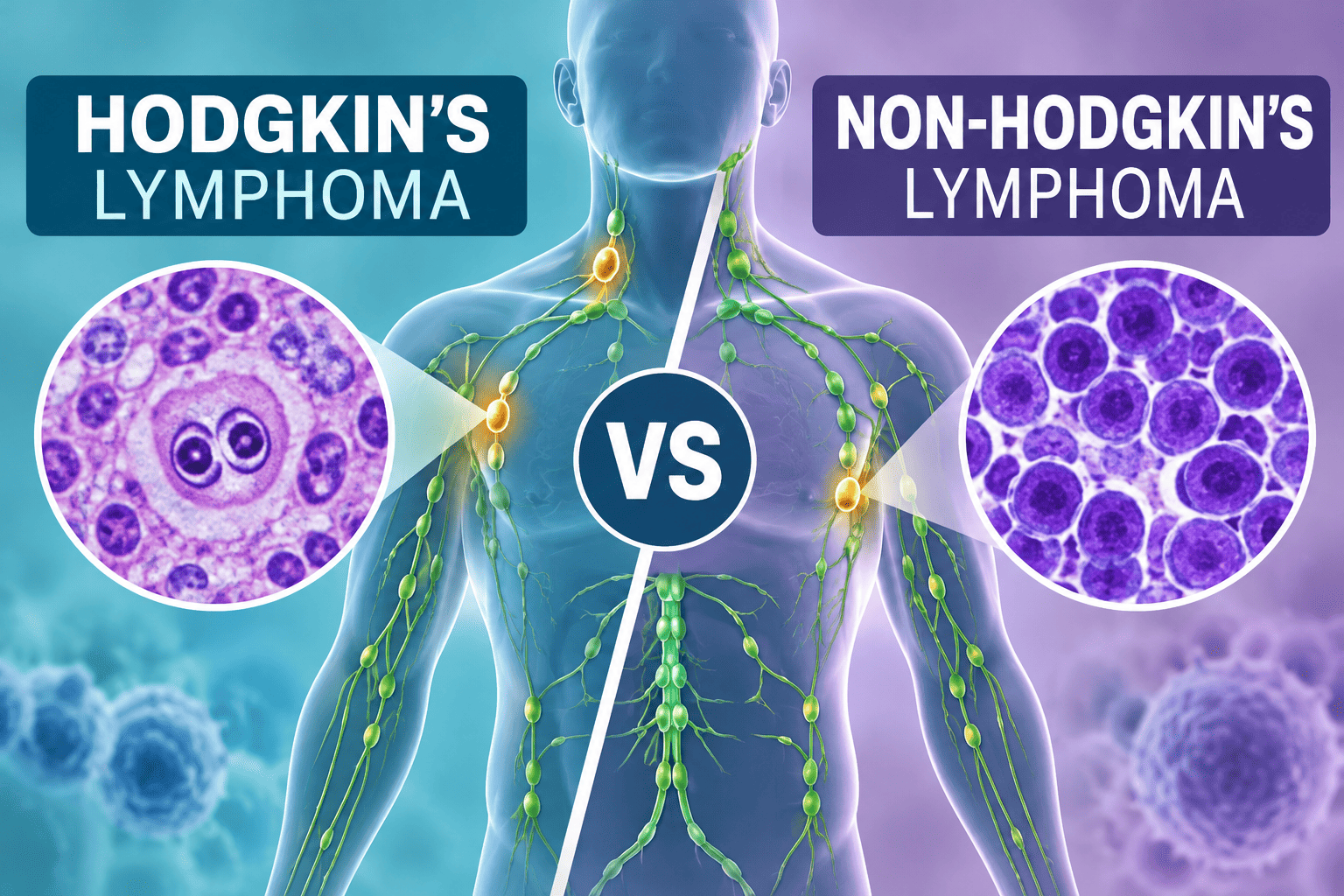
The defining biological difference between Hodgkin's lymphoma vs non-Hodgkin's lymphoma comes down to one specific finding under the microscope: the Reed-Sternberg cell.
Hodgkin's lymphoma (HL) contains these large, abnormal cells, which are its hallmark. Non-Hodgkin's lymphoma (NHL) does not. This single pathological difference has sweeping consequences for how each disease behaves in the body.
Who Gets Each Type in India?
Hodgkin's lymphoma tends to follow a bimodal age pattern, appearing most often in young adults between 15 and 35 years, and again in people above 55. It is more common in men and is strongly associated with Epstein-Barr virus (EBV) infection, which is relatively prevalent across India. In Indian patients, mixed cellularity is the most frequently seen subtype of Hodgkin's lymphoma, unlike the nodular sclerosis subtype more common in the West.
Non-Hodgkin's lymphoma presents differently. It is more common overall, and affects a wider age range. And in India, it shows up nearly a decade earlier than in Western populations, with a median age of around 54 years. Diffuse large B-cell lymphoma (DLBCL) is by far the most common NHL subtype seen in Indian hospitals, accounting for a large number of cases.
How Each One Spreads
One important distinguishing feature in the comparison of Hodgkin’s lymphoma vs non-Hodgkin’s lymphoma is the pattern of spread. Hodgkin's lymphoma tends to spread in an orderly and predictable fashion, from one group of lymph nodes to the next in sequence. This predictability allows for easier staging and more accurate treatment planning.
Non-Hodgkin's lymphoma is less predictable. It can arise in lymph nodes or outside them entirely, appearing in the stomach, skin, brain or bone marrow. It may be slow-growing (indolent) or fast-moving (aggressive), and the subtype determines which behaviour to expect.
Symptoms: More Similar Than Different
Both types share several common symptoms, which is one reason a biopsy is essential to distinguish them. Patients typically notice painless swelling of lymph nodes, unexplained fever, drenching night sweats and unintended weight loss.
These three together, fever, night sweats and weight loss, are called B-symptoms, and their presence carries staging implications for both diseases. Indian patients with NHL present with B-symptoms at a notably higher rate compared to patients in Western countries.
Treatment: Where the Paths Diverge
Hodgkin's lymphoma is one of the most treatable cancers when caught early. The standard first-line regimen in India is ABVD chemotherapy (Adriamycin, Bleomycin, Vinblastine, Dacarbazine), often combined with radiation for localised disease. Outcomes are generally favourable.
Non-Hodgkin's lymphoma is treated based on subtype. DLBCL, the most common type in India, is treated with R-CHOP immunochemotherapy. Indolent subtypes may be managed with a watch-and-wait approach in early stages. CAR-T cell therapy is now available at select oncology hospital centres in India, including Aster Hospitals, for relapsed or refractory cases.
The right oncologists, working within a multidisciplinary tumour board, will determine which protocol fits your specific diagnosis, stage and overall health profile.
Prognosis: Reasons to Be Encouraged
Survival data for both conditions has improved meaningfully over the past two decades. When treated at a specialist oncology hospital, early-stage localised Hodgkin's lymphoma has cure rates exceeding 92 to 95 percent. Even in the context of Hodgkin's lymphoma vs non-Hodgkin's lymphoma, NHL outcomes have improved substantially with newer regimens, and many patients with indolent types live for many years with well-managed disease.
A diagnosis is not a verdict. It is a starting point for a treatment conversation.
FAQs
Can lymphoma be completely cured?
Hodgkin's lymphoma, particularly in early and intermediate stages, has very high cure rates with standard chemotherapy and radiation. Many NHL subtypes are also highly treatable. The outcome depends on the specific subtype, stage at diagnosis and how promptly treatment begins.
Is a swollen lymph node always a sign of lymphoma?
Not at all. Swollen lymph nodes are most commonly caused by infections and usually resolve on their own. A lymph node that is painless, persists for more than three to four weeks, and is firm warrants evaluation. A biopsy is the only way to confirm or rule out lymphoma.
Do I need a second opinion after a lymphoma diagnosis?
It is entirely reasonable to seek one, and most specialists encourage it. Lymphoma diagnosis requires expert pathological review, including immunohistochemistry and sometimes molecular testing. Getting your biopsy reviewed at a dedicated cancer centre helps ensure your diagnosis, subtype classification and treatment plan are all accurate.