
Every year, thousands of Indians are told their oral cancer has reached an advanced stage. Not because the disease moved too fast, but because no one looked for it early enough. A structured screening, done by a trained clinician, can identify warning signs long before they become a diagnosis. Yet most people walk into an oncology hospital only after something has already started to hurt.
The mouth is one of the few places in the body where early cellular changes are directly visible to a trained eye, which makes oral cancer one of the most preventable tragedies in Indian healthcare.
This blog covers the oral cancer screening methods available in India today, who genuinely needs them and what the process looks like from start to finish, so you or your loved one can walk in informed and walk out reassured.
Oral Cancer Screening Methods Used in India
Visual Oral Examination
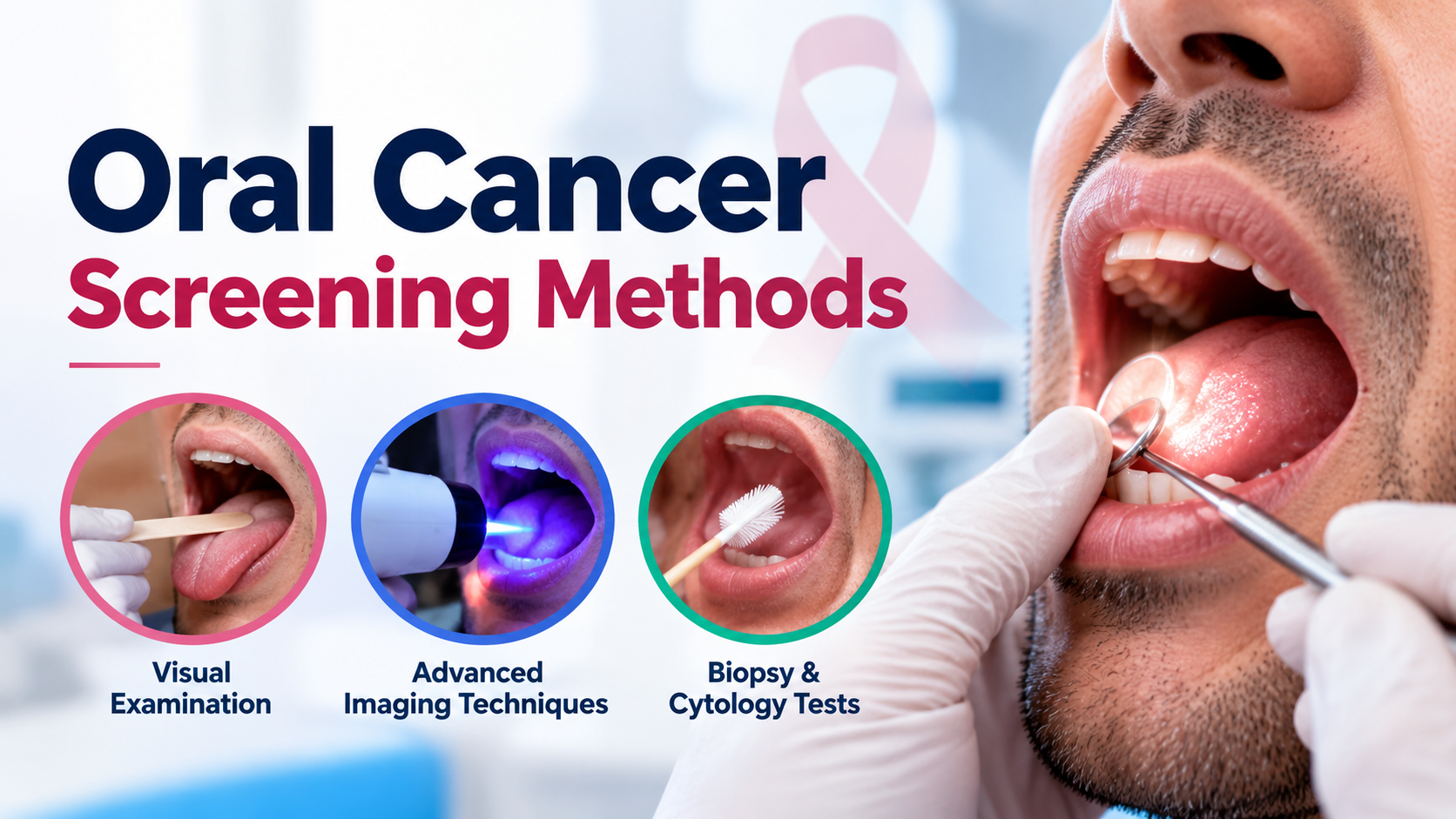
This is the most widely used and well-validated oral cancer screening test in India. A trained doctor or dentist examines your lips, tongue, inner cheeks, gums, the floor and roof of the mouth and the throat. They look for white patches (leukoplakia), red patches (erythroplakia), ulcers or any abnormal tissue that has persisted without explanation. The examination takes under ten minutes, requires no instruments and causes no discomfort whatsoever.
India's National Programme for Non-Communicable Diseases (NPCDCS) recommends this as a primary oral cancer screening test for adults above 30 years, particularly those who use tobacco or alcohol.
Toluidine Blue Staining
In this method, a blue dye is applied to the lining of the mouth. Normal tissue washes the dye off, while abnormal or potentially malignant tissue retains the colour. It is used alongside visual examination in higher-risk patients as well as helps the clinician decide whether a biopsy is needed. It is painless and takes only a few extra minutes.
Fluorescence-Based Screening
Specialised light-based devices illuminate the oral cavity and cause healthy tissue to appear a certain colour while abnormal areas fluoresce differently. Oral cancer early detection utilising fluorescence is especially helpful in identifying lesions that are not easily visible under normal light. Indian institutions and oncology centres are increasingly incorporating this into their screening toolkit.
Brush Biopsy and Oral Cytology
When a suspicious patch is found, a soft brush is used to collect surface cells from the area without any cutting or injections. The sample is examined under a microscope for abnormal cell changes. This method supports oral cancer screening methods in settings where a formal surgical biopsy may not be immediately necessary.
Who Should Get Screened and How Often
You should speak to an oncologist or visit an oncology hospital for an oral cancer evaluation if you use smokeless tobacco (gutka, khaini, paan with tobacco), smoke bidis or cigarettes, chew areca nuts or betel quid, drink alcohol regularly or have noticed a sore, patch or swelling in your mouth lasting more than three weeks.
For people with these risk factors, annual screening is advisable. For others, a check every three to five years after age 30 is a reasonable starting point.
What to Expect During a Screening Visit
There is no preparation involved. You do not need to fast or take any medication beforehand. The examining doctor will look inside your mouth systematically and may use a light or a staining solution if something warrants a closer look. If the result is normal, you leave reassured. If a suspicious area is found, the next step is simply a conversation about what needs to be done, not an immediate procedure.
An experienced oncologist at a dedicated oncology hospital will walk you through every finding clearly.
Final Thoughts
Oral cancer screening is not something to put off. It is quick, affordable, and in most cases, it gives you peace of mind. For those at higher risk, it is a genuine opportunity to catch something early when treatment is far simpler and outcomes are considerably better.
Book a visit, get checked and take one straightforward step toward staying ahead of something that is very manageable when found in time.
FAQs
Is oral cancer screening painful?
No. A visual oral examination involves no needles, no incisions and no discomfort. Even the brush biopsy, if required, is a surface-level procedure that feels like a gentle swab. Most patients find the entire process quick and unremarkable.
I do not have any symptoms. Should I still go for an oral cancer screening test?
Yes. An oral cancer screening test is most valuable precisely when there are no symptoms. Many early-stage lesions look like minor irritations and cause no pain, which is why waiting for symptoms often means waiting too long.
Where can I get an oral cancer screening done in India?
Oral cancer screenings are available at government primary health centres under the NPCDCS programme, at dental colleges and at specialist oncology hospitals with a dedicated head and neck or surgical oncology team.