
Oral cancer is one of those conditions where timing changes everything. Caught early, it is highly treatable. Caught late, it demands far more aggressive intervention and carries a heavier toll on quality of life.
India carries one of the highest burdens of oral cancer in the world, largely driven by widespread use of tobacco, betel nut and pan masala. Yet awareness about what to actually look for remains low among the general population.
This blog is written to change that. Here is clear, practical knowledge to help you act at the right time.
Why Oral Cancer Deserves More Attention in India
According to the Indian Council of Medical Research (ICMR), oral cancer accounts for nearly 30% of all cancers diagnosed in India, making it the most common cancer among Indian men.
The reasons are rooted in everyday habits that are deeply normalised across communities: chewing tobacco, gutka, khaini, betel leaf with areca nut and smoking bidis or cigarettes. Alcohol use adds to the risk further, especially in combination with tobacco. Chronic irritation from ill-fitting dentures and poor oral hygiene also contribute.
Understanding the early signs of oral cancer is not a medical speciality. It is something every adult, and every family member, should be able to recognise.
Where Oral Cancer Actually Develops
Oral cancer can develop on the tongue, inner cheeks, lips, the floor of the mouth, the roof of the mouth (hard palate) and the gums. The back of the throat, tonsils and base of the tongue fall under oropharyngeal cancer, which is closely related.
Most people assume oral cancer always starts as a visible mass. It rarely does. It tends to begin as something far more subtle.
Mouth Cancer Symptoms You Should Never Ignore
Patches That Do Not Heal
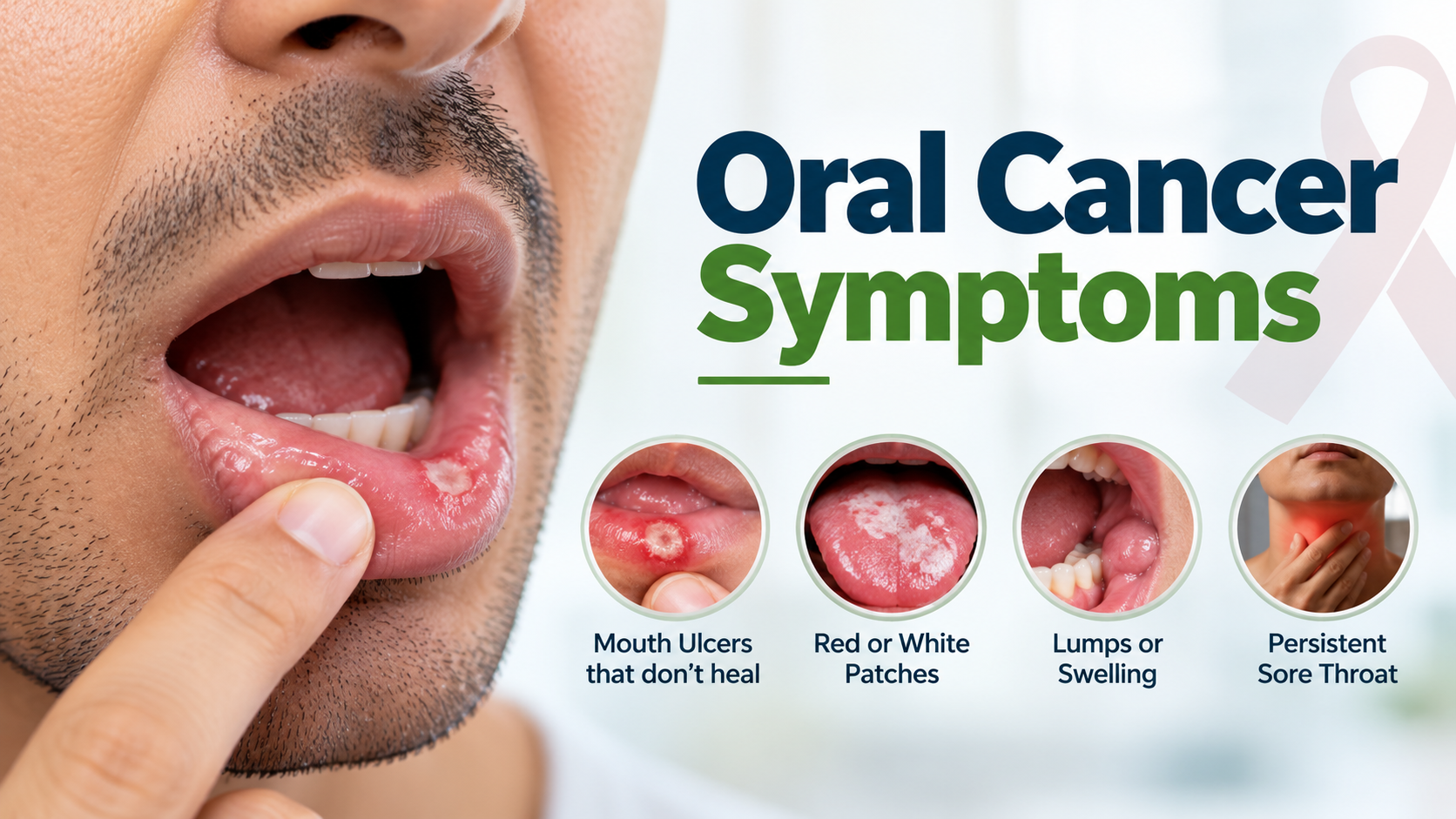
One of the most consistent mouth cancer symptoms is the appearance of a white patch (leukoplakia) or a red patch (erythroplakia) inside the mouth that has been present for more than two weeks. White patches are more common, but red patches carry a higher risk of being pre-cancerous or malignant. Both warrant an urgent evaluation by an oncologist.
A Sore or Ulcer That Refuses to Go Away
Mouth ulcers from minor trauma or heat typically resolve within 10 to 14 days. If an ulcer in your mouth, on your tongue, or on your lip has been present for longer than two weeks without any sign of healing, it is one of the clearest oral cancer signs and should not be dismissed as a routine sore.
Unexplained Pain, Numbness or Difficulty
Early signs of oral cancer often include a persistent sensation of pain or numbness in the mouth, tongue or throat that has no obvious cause. You may also notice difficulty chewing, swallowing or moving your jaw or tongue freely. A feeling that something is caught in your throat, or a voice that has become hoarse without a cold or infection, also falls into this category.
A Lump You Can Feel but Cannot Explain
A thickening or lump inside the cheek, on the tongue or along the jaw that does not resolve on its own is another of the significant mouth cancer symptoms. Similarly, a swelling in the neck or a lymph node that has been enlarged for more than three weeks needs investigation.
Changes in How Your Teeth Fit Together
Oral cancer affecting the jaw or gums can shift teeth or alter your natural bite. If your dentures suddenly feel loose or your teeth no longer align the way they used to, an oral examination is necessary.
What Happens When You Visit an Oncology Hospital
A visit to a qualified oncologist or an oncology hospital for an oral concern typically begins with a thorough clinical examination of the mouth, tongue, throat and neck. If something suspicious is found, a biopsy is the definitive next step. An incisional biopsy of the suspicious tissue is sent for histopathological examination, which confirms whether the cells are malignant. Imaging such as an MRI or PET-CT scan may follow to understand the extent of the disease.
The key takeaway is that the process is not dramatic. It is clinical, systematic and far better initiated early.
Recognising Oral Cancer Signs in People Around You
Sometimes it is a family member who notices before the patient does. If someone you care for has been complaining of a sore throat for weeks, has been struggling to eat, or you notice a change in how they speak, take those oral cancer signs seriously. Encourage them to see a doctor rather than wait it out.
Ending Note
Oral cancer is not inevitable, and it is not untreatable. What makes the difference, more than anything else, is how early it is identified. The early signs of oral cancer are visible, often felt, and recognisable if you know what to look for.
If you notice either of the signs listed above in yourself or a loved one, visit an oncology hospital and have it evaluated by an oncologist. This one step, taken early, can change the outcome entirely.
FAQs
Can oral cancer develop in people who do not use tobacco?
Yes, though tobacco and betel nut are the leading risk factors in India. Oral cancer can also occur due to HPV infection, chronic alcohol use, poor oral hygiene or prolonged irritation from damaged teeth and ill-fitting dental appliances.
Are white patches in the mouth always cancerous?
Not always. But white patches (leukoplakia) and red patches (erythroplakia) that persist beyond two weeks are considered pre-cancerous lesions until proven otherwise. An oncologist will perform a biopsy to determine whether the cells have undergone malignant changes.
How often should someone who uses tobacco or gutka get screened for oral cancer?
Anyone with a regular tobacco or betel nut habit should have an oral screening at least once a year, even in the absence of symptoms. Many oncology hospitals offer dedicated oral cancer screening programmes that include a thorough clinical examination and, when necessary, further investigation.